
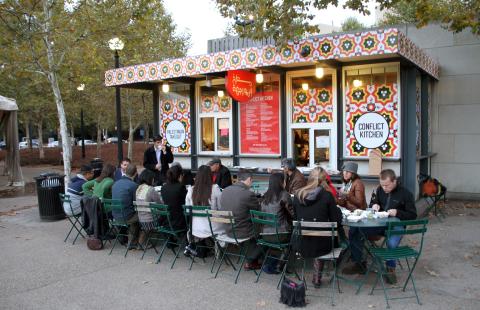
Conflict Kitchen: Reading and Fundraiser for Gaza Soup Kitchen
Thursday, July 17, 2025
6:30–8:00 PM
Join us for an evening of Palestinian food by Reem's, music by Clarissa Bitar, and a community reading on the occasion of the San Francisco launch of There Is No Life on Other Planets (2024). Originally published in 2014 by Conflict Kitchen, the book features interviews with Palestinian children living in the West Bank and Gaza. Ten years later, the book has been republished alongside eight new interviews, with some of the same children who are now young adults currently living in Gaza.
All new interviews were conducted in Gaza by Abeer A. in May of 2024, nearly seven months into a humanitarian catastrophe that has repeatedly displaced 2.2 million and killed an estimated 55,000 people, more than half women and children.
Data references, UN data and Gaza Health Ministry via PBS and UNRWA
The event is free and open to the public. All funds raised from the sale of the book will be donated to support the Gaza Soup Kitchen, a network of kitchens providing hot meals and clean drinking water to communities in Gaza.
This edition of "There is No Life on Other Planets" and Reem's catering for this event has been partially supported by emergentCNY (2018 - ongoing), a mutual aid network undercommoning throughout unceded Haudenosaunee land in rural Central New York, and Noon at Night (2023 - ongoing), a peripatetic classroom that prototypes creative adaptation to crisis - both initiated and co-stewarded by Conflict Kitchen co-founder / co-director Dawn Weleski in collaboration, partnership, and support with over 700 co-stewards.
ABOUT
Conflict Kitchen, a restaurant, art project, and non-profit founded by Jon Rubin and Dawn Weleski in Pittsburgh, PA, served cuisine from countries in conflict with the U.S. They collaborated with individuals from focus countries and local expats to produce everything from publications and performances to film festivals and school curriculum, expanding public engagement with the culture, politics, and issues of each region. The restaurant's identity rotated approximately every six months in response to geopolitical events. Operating daily from 2010-17, Conflict Kitchen used food and economic exchange to foster discussions about countries, cultures, and people often misrepresented by political rhetoric and media, inserting politically challenging counter-narratives into public life via a commercial business. Conflict Kitchen served as a dynamic platform for recognizing ethnic diversity in the post-industrial city of Pittsburgh by introducing the city's first Cuban, Iranian, Afghan, Venezuelan, North Korean, Haudenosaunee, and Palestinian restaurants.